
The 4th Annual Gender Platform brought together over 100 representatives from government, industry, civil society, brands, and trade unions to advance action against gender-based violence and harassment (GBVH) in Cambodia’s garment, footwear, and travel goods (GFT) sector. Themed “Speaking Up, Building Collective Strengths: Ending GBVH in Cambodia’s GFT Sector Through Collaboration, Innovative and Inclusive Solutions,” the gathering underscored the urgency of addressing GBVH as both a human rights issue and a driver of sustainable growth in the country’s most vital export industry.
Co-organized by the Deutsche Gesellschaft für Internationale Zusammenarbeit (GIZ) GmbH project GIZ-FABRIC Cambodia, the Life and Building Safety (LABS) Initiative, CARE Cambodia, the Responsible Business Hub Cambodia, and EuroCham’s Garment & Manufacturing Committee, the platform reaffirmed that tackling GBVH requires coordinated action across the public and private sectors. Senior officials from the Ministry of Labour and Vocational Training (MLVT) and the Ministry of Women’s Affairs (MoWA) joined factory leaders, worker representatives, and development partners to discuss policy reforms, survivor-centered solutions, and the critical role of international brands in shaping safer workplaces.
A highlight of this year’s platform was the launch of the Women Empowerment Network (WE Network), which builds upon the success of the Women Empowerment House (WE House) initiative. The network expands community-based approaches to GBVH prevention and survivor support, creating safe spaces for women workers and strengthening referral mechanisms. The event also showcased innovations such as grievance platforms, GBV reporting apps, financial literacy programs, and collaborative campaigns led by local NGOs, unions, and brands.
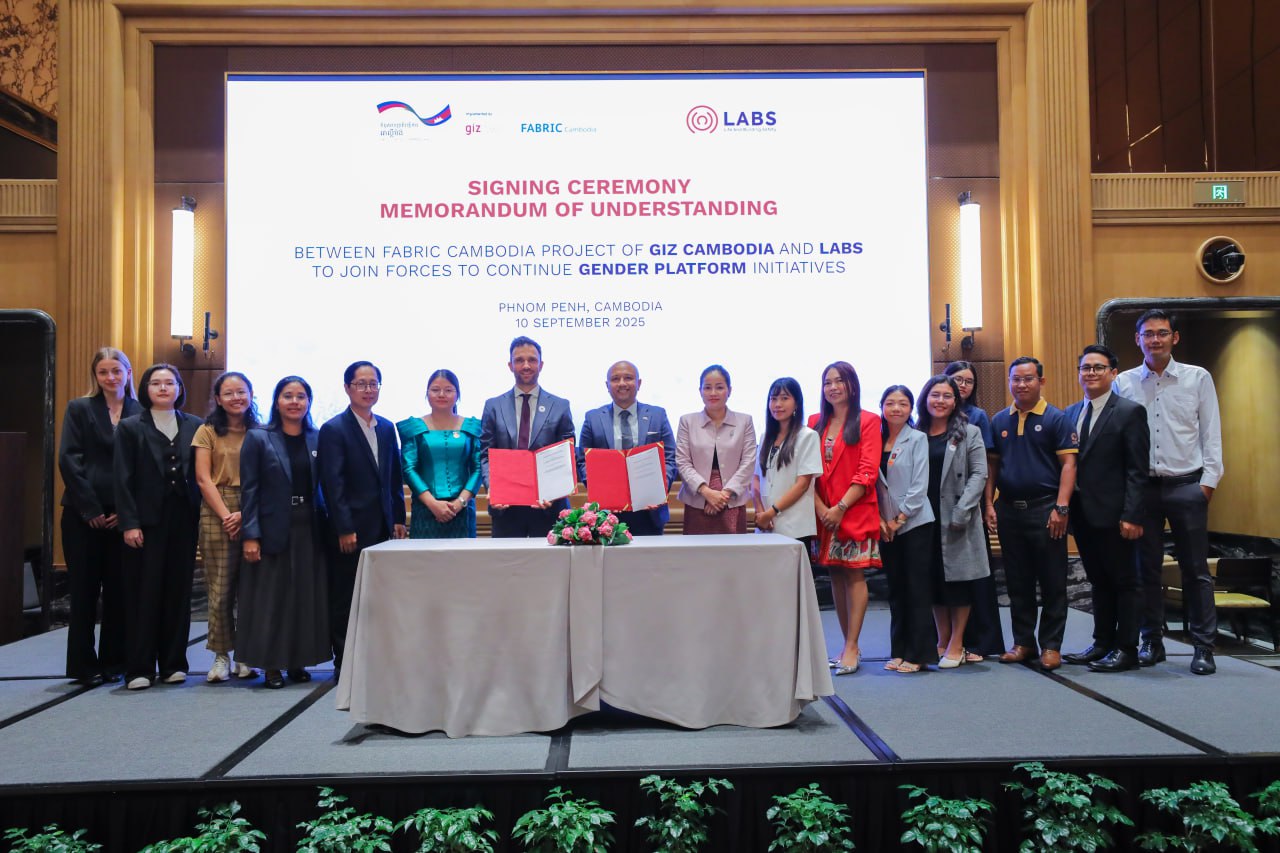
The gathering also marked the signing of a new Memorandum of Understanding between the GIZ project FABRIC Cambodia and the LABS Initiative to formalize ongoing collaboration in advancing gender equality and workplace safety in Cambodia’s garment sector. The agreement signals a shared commitment to strengthening multi-stakeholder partnerships and scaling interventions that protect workers’ safety and dignity.
Voices from the Platform
Her Excellency Sovann Vannaroth, Permanent Secretary of State, Ministry of Labour and Vocational Training, emphasized: “Eliminating gender-based violence and harassment in the workplace is a shared responsibility of all stakeholders, aimed at promoting labor rights and enhancing productivity.”
Pramit Chanda, Global Director – Textile and Manufacturing, IDH, and spokesperson for the LABS Initiative, noted: “Addressing complex challenges such as gender-safety requires collective action from all stakeholders – government bodies, industry leaders, civil society, and workers. By working together, we can build safer workplaces that empower workers and contribute to the long-term sustainability and growth of the sector.”
Hasso Anwer, Project Director of the FABRIC Cambodia project at GIZ Cambodia, shared: “The annual Gender Platform provides a critical space for us to come together and develop approaches for Women Empowerment in the GFT industry and beyond. Addressing GBVH is not the responsibility of one actor alone; it requires an unwavering and shared commitment by all industry stakeholders. With our flagship initiative, WE House, and our newly launched WE Network, GIZ will continue supporting these efforts in collaboration with our partners.”
Sinuon Hun, Technical Advisor for Advancing Women and Girls, CARE Cambodia, added: “Ending gender-based violence and harassment in Cambodia’s GFT sector demands bold collaboration—where government, civil society, and industry unite to drive survivor-centered, sustainable change. This Gender Platform gives us a crucial opportunity to continue the stakeholders’ commitment, investment, and collaborative aspiration toward gender equality and ending GBVH in the GFT sector in Cambodia.”
The discussions at this year’s platform built on momentum from previous gatherings, which have pushed for stronger reporting mechanisms, digital tools for GBVH prevention, and greater male engagement in workplace gender equality. Despite progress, participants acknowledged ongoing challenges such as cultural norms that enable harassment, underreporting of incidents, and gaps in survivor services. The 2025 platform called for unified training approaches, stronger legal enforcement, and increased brand accountability, emphasizing that collective action is essential to transform the industry.
The Life and Building Safety Initiative (LABS) successfully conducted the second meeting of the Platform for Safety in Apparel and Footwear Industry (PSAFI), a collaborative platform dedicated to advancing safety and sustainable development in India’s apparel and footwear sectors. PSAFI offers a trusted, neutral forum where industry stakeholders can come together to discuss, exchange insights, and collectively address safety challenges.
The event was addressed by Dr. Lalit Gabhane, Director General of the National Safety Council, who emphasized that the essence of a safety manager is rooted in a mindset where every individual contributes to driving the safety culture, underscoring the collective responsibility of all employees in fostering safer work environments.
Chief Guest Mr. Navneet K. Mohan, Joint Director of Factories, Government of Karnataka, also shared his insights on the critical role of leadership in driving a safety-first culture within organizations. He highlighted how leadership at all levels can serve as a catalyst for instilling safety values and ensuring that safety protocols are effectively implemented across the sector.
Around 140 members from 35 organizations participated in the event, showcasing broad industry engagement. Attendees included representatives from major organizations such as Arvind Ltd, Jay Jay Mills, Indian Designs, Radnik, PeeEmpro, Jak Leather, Bharatiya International Ltd, and Texport Syndicate, along with leading global brands like Amazon, Target, Nike, and Walmart. Stakeholders unanimously agreed to form a collective working group to drive safety culture and address compliance and risk mitigation issues across the apparel, footwear, and textiles industries.
Participants further acknowledged the benefits of adopting new technologies and integrating artificial intelligence (AI) to monitor and enhance safety management systems. These advancements were recognized as a crucial step toward real-time monitoring and proactive risk management, which would help ensure the safety of factory operations.
A key point raised during the discussions was the need to increase awareness of safety as a core cultural value, with an emphasis on appointing dedicated safety managers or promoters in factories to champion these efforts. Factory representatives collectively requested that statutory bodies streamline compliance processes while recognizing and rewarding facilities that have successfully adopted programs like LABS, which are setting a positive example in the industry.
In addition, a workshop on the role of safety officers was conducted by a representative from the National Safety Council of India, further underlining the importance of skilled professionals in maintaining and enforcing safety standards.
PSAFI continues to invite industry professionals, policymakers, workers’ representatives, and other stakeholders to join the platform and contribute to the collective effort to improve safety standards across India’s apparel and footwear industries.
About PSAFI
The Platform for Safety in Apparel and Footwear Industry (PSAFI) is an initiative established by the Life and Building Safety Initiative (LABS) to promote fire, electrical, and building safety in India’s apparel and footwear sectors. PSAFI provides a neutral space for stakeholders to collaborate, share ideas, and drive coordinated actions aimed at fostering a preventative safety culture. By facilitating consultation and cooperation among stakeholders, PSAFI seeks to enhance the management of building safety risks and promote sustainable, safe practices across the industry.
The Life and Building Safety (LABS) Initiative is happy to announce a significant milestone in its commitment to fostering safer working conditions and sustainable practices within the global apparel, footwear and accessories supply chain. Amazon, a leading e-commerce and technology company, has officially joined the LABS Initiative.
As part of this collaboration, the LABS Initiative will work closely with the apparel factories supplying to Amazon in Cambodia, India, Indonesia and Vietnam, focused on implementing comprehensive assessments and safety training processes.
Amazon’s decision to align with the LABS Initiative underscores its dedication to elevating safety standards in manufacturing facilities and advancing responsible and sustainable business practices. This collaboration represents a shared commitment to driving positive change within the industry
“As advocates for safe working environments and sustainability across the supply chain, we are delighted to welcome Amazon into the LABS Initiative. Together, we look forward to working collaboratively to ensure the well-being of workers and to contribute to responsible sourcing practices,” said Pramit Chanda, Global Director – Textile & Manufacturing – IDH and Spokesperson for LABS Initiative.
“Realizing safe, equitable, fair, and sustainable supply chains has been a longstanding priority for Amazon across all our businesses. Recognizing our responsibility to uphold safe working environments, we are pleased to join the LABS Initiative. This collaborative initiative will strengthen our efforts to enhance building and fire safety and promote worker well-being. We remain committed to continually improving working conditions,” said Leigh Anne DeWine, Director of Social Responsibility, Amazon.
The Life and Building Safety (LABS) Initiative is delighted to announce the partnership with apparel, Nike, a leading athletic footwear and accessories manufacturer. This collaboration is a significant step forward in the ongoing commitment to fostering safer working conditions and sustainable practices within the global supply chain.
As part of this collaboration, the LABS Initiative will work closely with factories supplying to Nike to enhance safety standards, ensuring they undergo comprehensive assessments and safety training processes
LABS brings together industry leaders, non-governmental organizations, and stakeholders to collectively address and enhance life and building safety in factories worldwide. Nike’s decision to join the LABS Initiative signifies a shared commitment to elevating safety standards in manufacturing facilities and promoting responsible and sustainable business practices and further strengthens the foundation pillar for the program.
The LABS Initiative is excited to embark on this journey with Nike, collectively driving positive change and setting new benchmarks for safety and sustainability in the athletic apparel and footwear industry.
In a significant stride toward enhancing safety standards in workplaces, the Life and Building Safety (LABS) Initiative announces the successful inclusion of over 500 factories under its comprehensive program across its countries of operations, including India, Vietnam, Cambodia, and Indonesia.
Since its inception, the Initiative has been dedicated to fostering a culture of safety in the textile, apparel and footwear manufacturing sector. The achievement of this milestone not only underscores the commitment to ensuring the well-being of workers but also serves as a powerful testament to the collective intention of factories and the industry to transition to safer practices and embed a culture of safety.
LABS places a strong emphasis on implementing rigorous safety protocols and continuous improvement practices to promote safe working environments. With a footprint extending to over 500 factories, LABS has positively impacted over a million workers, creating a safer workplace for all.
Pramit Chanda, Global Director – Textile and Manufacturing at IDH and Spokesperson for LABS, shared their thoughts: “This achievement has been a result of collaborative efforts and commitment of all stakeholders involved. It reflects the industry’s strong intention to embed a safety culture. LABS remains steadfast in its mission to create safer working conditions, and we are proud to witness the positive transformation of the sector.”
LABS is a comprehensive effort involving various stakeholders, including brands including Gap Inc., Nike, Target, VF Corporation, and Walmart, along with government agencies and non-profit organizations. The approach encompasses robust training programs, safety assessments, and the implementation of best practices to ensure a sustainable safety culture.
Since its launch in 2019, LABS has made significant progress in conducting over 492 assessments in factories and achieving a 77% remediation rate. LABS also offers capacity-building support through training programs and technical assistance to enhance stakeholders’ knowledge and skills in life and building safety. So far, the Initiative has conducted over 924 safety training sessions.
As we celebrate this milestone, LABS Initiative remains resolute in its commitment to further expanding its reach, making factories safer, and contributing to the overall well-being of workers.
The Life and Building Safety Initiative (LABS) and DKI Jakarta Regional Disaster Management Agency (BPBD DKI Jakarta) has entered into a strategic collaboration for improving safety standards in the public buildings in DKI Jakarta.
This collaboration aims to integrate LABS’ expertise in building safety with BPBD DKI Jakarta’s proficiency in disaster preparedness and response, creating a comprehensive approach to safeguarding lives and infrastructure.
As a part of this collaboration, the organizations will develop evaluation and assessment modules to improve life safety in public buildings in DKI Jakarta by preparing a guiding document dedicated to evaluation of public buildings for fire, electrical and building safety.
Pramit Chanda, Global Director – Textile & Manufacturing – IDH and Spokesperson for LABS Initiative, said, “As we embark on this transformative collaboration with BPBD DKI Jakarta, we recognize the immense value of merging our efforts to create safer buildings. LABS is committed to bringing our global expertise to the table, working hand-in-hand with BPBD DKI Jakarta to address building safety.”
Drs Isnawa Adji, M.A.P, Chief Executive of the DKI Jakarta Disaster Management Agency said: “This collaboration marks a significant step forward in our commitment to enhancing safety standards and promoting life safety in public buildings across the province of DKI Jakarta. We express our sincere gratitude to LABS and IDH for their invaluable contribution to the development of our assessment module. By adopting the international LABS standard, we aim to elevate our safety standards to a level that sets DKI Jakarta as a model city for others to emulate. With the LABS Standard, Jakarta will become a global city, disaster resilient and more livable. This collaboration is not just a partnership; it is a joint commitment to creating safer buildings and promoting life safety. We welcome this opportunity to work together towards a safer and more resilient DKI Jakarta.”
Rian Sarsono, Chair of the Prevention Affairs Subgroup, BPBD DKI, said, “The assessment module developed using LABS Standards can certainly increase the capacity and capability of the functions of the DKI Jakarta Regional Disaster Management Agency. This is very important considering that one of our tasks is to establish guidelines and direction in accordance with the policies of the Regional Government and the National Disaster Management Agency regarding Disaster Management efforts which include pre-disaster, disaster emergency response and post-disaster in a fair and equitable manner and in accordance with needs and developments.”
Basuki Rakhmat, Chair of the Subgroup for Community and Institutional Empowerment Affairs – BPBD DKI, said: “Disaster prevention can be done well if the government has competent, appropriate, and up-to-date assessment guidelines. By adopting the LABS Methodology & Standards, it is hoped that various elements, both government and private, can jointly commit to the implementation of these safety standards, so that DKI Jakarta can have building facilities and public facilities that are resilient to disasters.”
The LABS and BPBD DKI Jakarta collaboration reflects a shared commitment to creating safer buildings and promoting life safety. It sets momentum for a broader dialogue on safety standards, and serves as a catalyst for wider change, aligning private and public sector efforts towards life and building safety.
The Life and Building Safety (LABS) Initiative, has achieved a significant milestone by improving the safety of 1 million workers in India, Vietnam, Cambodia, and Indonesia. This Initiative was introduced four years ago and has played a crucial role in enhancing workplace safety and promoting responsible industry practices in key apparel-producing countries.
The LABS Initiative is a collaborative, industry-driven program that aims to elevate life and building safety standards in the apparel, footwear, accessories and home-textile industries. It focuses on creating safer working conditions for factory workers while also mitigating preventable safety risks such as fires, electrical hazards, and structural issues.
Pramit Chanda, the Global Director for Textiles & Manufacturing at IDH, emphasized the commitment to creating a lasting positive impact on workers’ lives and fostering a culture of safety within industries. While celebrating this achievement, IDH looks forward to expanding the reach of the LABS initiative to make an even greater impact in the future.
LABS is a comprehensive effort involving various stakeholders, including brands including Gap Inc., Target, VF Corporation, and Walmart, along with government agencies and non-profit organizations. The program assesses factories, monitors safety risks, and provides frameworks for mitigation and remediation. Since its launch in 2019, LABS has made significant progress in conducting over 465 assessments in factories and achieving a 77% remediation rate.
LABS also offers capacity-building support through training programs and technical assistance to enhance stakeholders’ knowledge and skills in life and building safety. So far, the Initiative has conducted over 849 safety training sessions.
Overall, the Life and Building Safety Initiative promotes accountability, transparency, and continuous improvement within the industry. It has made significant strides in creating safer workplaces and fostering responsible practices. IDH remains dedicated to this mission, aiming to drive transformative change in the industry as it continues to move forward with the program.
The Life and Building Safety (LABS) Initiative announced the launch of its operations in Indonesia today. The Initiative aims to promote safer working conditions for factory workers by mitigating preventable fire, electrical, and structural building safety risks in key production countries in the apparel, footwear, accessories, and home textile sectors in a targeted way.
As a comprehensive, multi-stakeholder effort that brings together brands, industry stakeholders, government agencies, and non-profit organizations, LABS promotes sector-wide transformation to promote safe practices and create safer work environments. Currently, brands including Gap Inc., Target, VF Corporation, and Walmart are participating in the LABS program.
LABS facilitates the assessment of factories and provides a framework for monitoring, mitigating, and remediating the safety risks identified. Since the program’s launch in 2019, LABS has made significant progress in reaching out to over 837,000 workers and conducting over 400 assessments in factories. LABS has engaged with the factories to remediate issues that were identified during assessments and achieved a 77% remediation rate.
In addition to assessments and remediation efforts, LABS provides capacity-building support to stakeholders through training programs and technical assistance to enhance their knowledge and skills in life and building safety. So far, the Initiative has conducted over 650 safety trainings.
LABS is currently operational in India, Vietnam, and Cambodia, and the expansion into Indonesia is a strategic move that aligns with the program’s ambition to mitigate safety risks in key apparel production countries in the sector.
“At LABS, we are committed to improving worker safety and will build on our learnings and engagements to build partnerships in Indonesia,” said Pramit Chanda, Global Director for Textiles & Manufacturing at IDH. “We thank all our stakeholders including brands, factory owners, government, safety and training firms, civil society organizations, and workers, who have strengthened the program and supported it’s roll out. We look forward to collaborating with partners in Indonesia to drive meaningful change and ensure that worker safety remains top priority in the sector in the country”.
Speaking about the program launch in the country, Mr. Ir. Kimron Manik, Director of Construction Sustainability, Directorate General of Construction, Ministry of Public Works and Public Housing of the Republic of Indonesia said, “With the launch of the LABS Initiative in Indonesia, we hope that we can collaborate and develop standard procedures to help provide safer working conditions for the workers that is also aligned to laws and regulations in the country.”
Mr. Lukman Hakim, Deputy Assistant of Policy Support for Government and National Values of the Vice President’s Office, Republic of Indonesia added: “We are glad that LABS has initiated the platform for safety in taking care of human resources and physical resources which present an opportunity to make improvements in all fields. In this regard, we look forward to LABS Initiative helping stakeholders in Indonesia in a collaborative manner and addressing issues together in a steadfast way, for providing a safe and healthy environment to workers in all sectors.”
The LABS Standards and Methodology are based on international best practices and codes, including, but not limited to, the International Building Code and National Building Code of India, Vietnam, Cambodia and Indonesia. In addition to applicable country laws, factories commit to adhering to a harmonized, country-level standard regarding structural, fire, and electrical safety under LABS. IDH supports the overall facilitation of LABS as well as the development of the operational setup.
The Initiative will operate in all major production hubs of Indonesia and is expected to benefit approximately 2,75,000 workers.
Phnom Penh, Royal Kingdom of Cambodia, November 2, 2022
Today, Life and Building Safety (LABS) Initiative (“The Initiative”) launched the Platform for Gender Equality in Apparel & Footwear in Cambodia” (PGEAFC) at a workshop organized jointly with the Garment Manufacturers Association of Cambodia (GMAC) in Phnom Penh, Cambodia.
The Platform will provide an opportunity for like-minded partners to discuss and address key issues related to gender in the apparel, footwear, and garment sectors in Cambodia, such as pay gaps, leadership opportunities for women in the sector, and working conditions.
Pramit Chanda, LABS Spokesperson said, “The Platform will offer a trusted, neutral space for different actors to discuss gender issues in the Cambodian apparel and footwear industry and to exchange ideas and insights on how the stakeholders can work together to scale interventions and accelerate actions. The forum will facilitate coordination, alignment, and action between all stakeholders.”
Ken Loo, Secretary General of GMAC, mentioned, “Gender equality and safer working Conditions are some of the most important elements for a rapidly growing country such as Cambodia. It helps to drive the local economy by providing a diversified perspective in decision-making. With roughly 80% of the garment workers in Cambodia being women and this sector being a key economic driver for employment, foreign direct investment and exports, Cambodian businesses will need to lean even more on diversifying their leadership team, investing more in upscaling the workforce and listening to their team’s voices.”
The workshop today saw participation from organizations including Cambodia’s Ministry of Women’s Affairs and Ministry of Labour and Vocational Training, CARE Cambodia, American Chamber of Commerce, European Chamber of Commerce, Better Factories Cambodia, UNDP, Oxfam, GIZ, and apparel brands including H&M, C&A, VF Corp., Target, Marks & Spencer, and Gap Inc. The stakeholders in the sector discussed issues related to gender equality and created a roadmap for collaborative action to learn, integrate and coordinate across initiatives being taken by the government, civil society, and private sector organizations.
Speaking at the workshop, Arron Goldman representing ILO’s Better Factories Cambodia, said, “Ending gender-based discrimination, developing understanding around the challenges women face balancing paid and unpaid work, making sure women have a voice and are represented while helping develop skills and leadership, are is important on not only a business level but a societal level.”
Koung Sorita, representing Cambodia’s Ministry of Women’s Affairs, said, “We need actors from the public and private sectors to come together to solve the problem. Women are the backbone of the economy, and supporting women directly contributes to economic growth in Cambodia and provide job opportunities for Cambodian people. This in particular is true in the garment sector, where women represent around 90 percent of the workforce.”
Sovattha Neou, Country Director – Cambodia, CARE, added, “The cost of sexual harassment is around 89 million USD per year or 0.52 percent of Cambodia’s GDP. This is a result of absenteeism, staff turnover, decreased presentism, and reduced productivity. Studies show that factories saw some 112,000 days where workers were absent due to sexual harassment. We also see around a 40 percent loss in productivity from victims of sexual harassment. Not only should sexual harassment be eradicated for the benefit of society, but the private sector should actively implement policies and practices to create a safe work environment which protects their employees whilst improving its productivity.”
The workshop will be held annually with the sector stakeholders including private, government, and civil society organizations for continued dialogue over gender-equality issues.
LABS Initiative was launched in Cambodia in May 2022. It promotes safer working conditions for factory workers in the apparel, footwear, and accessories industry by assessing factories and providing a framework for their monitoring, mitigating, and remediating.
The Initiative will operate in all major hubs of Cambodia including Phnom Penh, Kandal, Kampong Cham, Kampong Chhnang, Kampong Speu, and Takeo, and is expected to benefit approximately 206,000 workers in 2022.
On May 18, IDH, The Sustainable Trade Initiative launched its Life and Building Safety (LABS) Initiative (the “Initiative”) in Cambodia. The Initiative promotes safer working conditions for factory workers in the apparel, footwear, and accessories industry by assessing factories and providing a framework for their monitoring, mitigating, and remediating.
LABS has been operational in India and Vietnam since 2019, where over 572,000 workers have benefitted from the program. Expanding into Cambodia aligns with the program’s ambition to mitigate preventable fire, electrical, and structural building safety risks in key production countries in the sector.
The Initiative will operate in all major hubs of Cambodia including Phnom Penh, Kandal, Kampong Cham, Kampong Chhnang, Kampong Speu, and Takeo and is expected to benefit approximately 206,000 workers in 2022.
With a pressing need to protect workers from structural, fire, and electrical safety risks, several leading apparel brands approached IDH to create a coherent and consistent worker-safety program; thus leading to the development of the Initiative. Major brands including Gap Inc., Target, VF Corporation, and Walmart joined the program that cover small, medium, and large enterprises in these countries.
LABS participants, facilitated by the LABS Secretariat, engage with local stakeholders, such as industry associations, civil society organizations (CSOs), governments, and institutes to create better safety policies and provisions. The LABS Standards and Methodology are based on international best practices and codes, including, but not limited to the International Building Code and National Building Code of Cambodia. In addition to applicable country laws, factories commit to adhering to a harmonized, country-level standard regarding structural, fire, and electrical safety under LABS. IDH supports the overall facilitation of LABS as well as the development of the operational setup.
Pramit Chanda, Global Director for Textiles & Manufacturing, IDH and LABS Spokesperson said, “Aimed at improving worker safety in the apparel and footwear industries, LABS effectively identifies and mitigates the potential risks related to fire, electrical, and structural building safety and evacuation. Our expansion into Cambodia is aligned with our goals to scale the programs in key apparel and footwear hubs. LABS continues to build on the learnings and engagements from the work in India and Vietnam.”
LABS aims to set a safety standard against which apparel and footwear factories are assessed. The LABS assessment is not a code-compliance check; it defines a required level of safety based on international best practices considering the local context. All technical standards consist of an interrelated set of measures which, when taken together, are assumed to provide an acceptable level of safety in a building.